
If you grew up in the 80s or 90s, you probably remember them: books where you decided what happened next, and one wrong turn could end the story on page 40. Those books never disappeared. They are called gamebooks, and for kids ages 7-12 they are still one of the most reliable ways to turn "I don't like reading" into "let me try a different path."
So, what is a gamebook?
A gamebook is a story your child plays rather than watches from the outside. Instead of one fixed plot that runs from the first page to the last, the book stops every few pages and hands your child a decision. Open the door or walk away? Trust the stranger or follow the map? Each choice sends them to a different page, and the story branches from there.
The result is that no two readings are the same, and the ending your child gets is the one they earned. That single change — from passenger to driver — is what makes gamebooks click with children who bounce off ordinary chapter books.
How a gamebook actually works
- Your child reads a short section — usually one or two pages.
- The section ends with a decision, and each option points to a different page number.
- They pick one and jump to that page. The story continues from their choice.
- After a handful of decisions they reach an ending. Some are triumphant, some are funny, some send them back to the start with a lesson.
- Then comes the good part: they flip back and try the path they didn't take.
No dice, no rule book, no character sheet. If your child can read a page and pick a number, they can read a gamebook.
Gamebook, Choose Your Own Adventure, interactive fiction: what is the difference?
These three terms get used interchangeably, and it causes a lot of confusion when parents go looking for one.
- Choose Your Own Adventure is a specific book series that launched in the late 1970s. It became so popular that the name stuck as shorthand for the whole format — a bit like calling every vacuum a Hoover.
- Gamebook is the general term for any printed book where the reader's choices steer the story. Choose Your Own Adventure was one gamebook series among many.
- Interactive fiction usually means the digital version: text adventures and story apps you play on a screen.
So if you have been searching for "choose your own adventure books" and coming up with out-of-print listings from 1985, what you actually want is a modern gamebook. The genre is alive, and it is being written for today's kids.
Why gamebooks work so well for ages 7-12
This age range is exactly where a lot of children quietly stop reading for pleasure. School reading gets longer and denser, screens get more interesting, and books start to feel like an assignment. Gamebooks push back on all three at once.
- Your child is in charge. Nobody is telling them what happens next. That sense of control is the single biggest reason reluctant readers stay on the page.
- Short sections mean frequent wins. A child who finds a 200-page novel intimidating can finish a section in two minutes and feel like they made progress.
- It is the same loop as a video game. Decide, act, see the consequence. Children who love gaming already know how to enjoy this rhythm — the book just moves it off the screen.
- Finishing is not the end. With multiple endings, "I finished it" turns into "I want to see what happens if I go left instead." You get re-reading without ever asking for it.
If that describes a child in your house, these two guides go deeper: how to get a reluctant reader to actually finish a book and the best books for kids who say they hate reading.
What a gamebook is not
A few things worth clearing up before you buy one:
- It is not a puzzle or activity book. There is nothing to fill in, and nothing gets used up. It is a real story with real characters.
- It does not need a grown-up. Your child can read it alone, though sharing the decisions out loud is genuinely fun.
- It is not automatically scary. Some gamebooks written for teens are dark. Books written for 7-12 year olds can be adventurous and suspenseful without anything that keeps a child awake.
- It is not a shortcut. Your child still reads every word of the path they choose. The choices are the reward, not a way around the reading.
How to pick a good first gamebook
- Match the theme to the obsession. This matters more than reading level. A child who lives inside a game will pick up a book about a video game world without being asked.
- Check how many endings it has. More endings means more reasons to go back. Around 15 is a sweet spot for this age.
- Look at section length. One or two pages between decisions keeps momentum. Five pages starts to feel like homework again.
- Mind the age band. A gamebook aimed at teens can carry themes and vocabulary that lose an eight-year-old.
Where to start
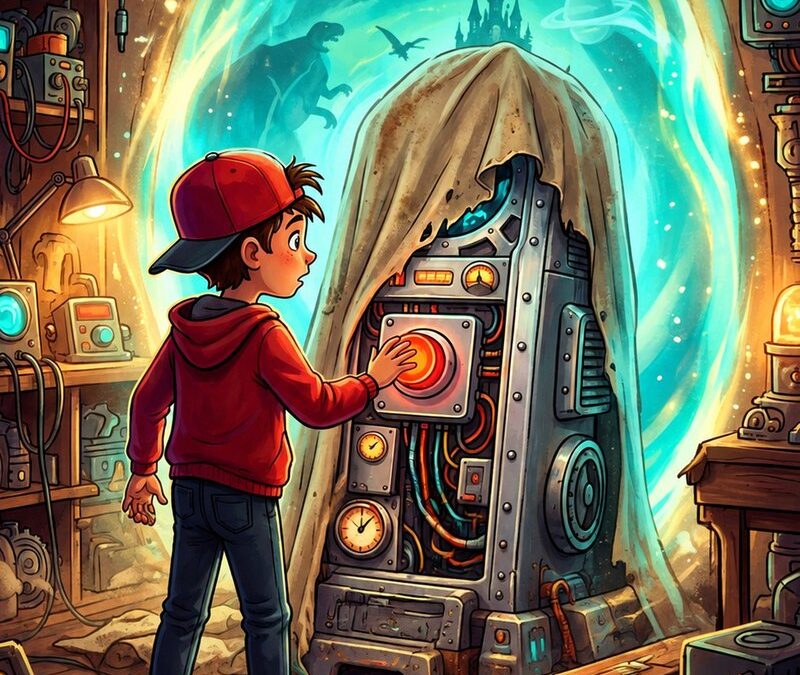
The cheapest way to find out whether your child likes the format is to try one for free. The Portal is a complete pick-your-path gamebook we will send to your inbox at no cost — enough to see whether the format lands before you spend anything.
If it does, pick the next one by what your child is already into:
- Gaming — In the Realm of Videogames or The Lost Pixel
- Mystery and detective work — Who Stole the Great Clock or The Mystery of the Chocolate Factory
- Space and science fiction — Galactic Rebellion or My Neighbor is an Alien
- Magic and fantasy — The Magic Library or The Last Unicorn
- History and time travel — The Secret of the Time Machine or Adventures Among Vikings
Every Decide Your Destiny gamebook is written for ages 7-12, runs on short sections and around 15 endings, and starts at $3.90. Browse the full collection and let your child pick the one they cannot stop thinking about — that is usually the one that works.